Wednesday, July 20, 2011

Of Moon Walks and Broken Dreams: Rendering a Distant Memory

a repost --- in honor of the 42 anniversary of the moon walk...


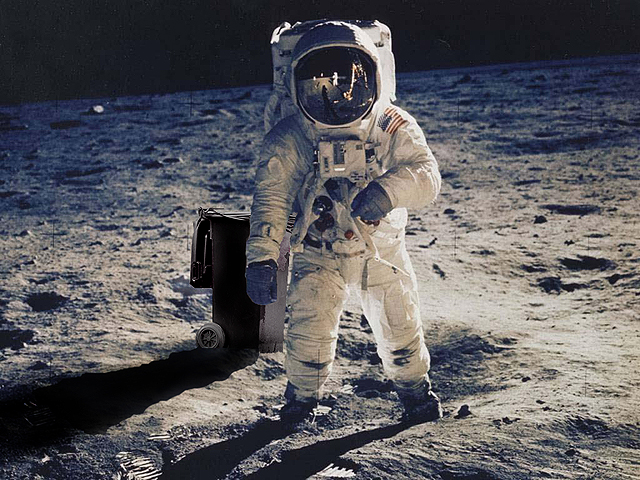
I have been trying to write about the 40th anniversary of Apollo 11 since last week. I wanted to write a piece that talked about where I was on that historic evening during the summer of 1969. The summer was tumultuous for all sorts of reasons - political, historical and personal. It was one of those touchstone moments in my life where everything was changing and falling apart around me, and I wouldn’t understand the significance of the confluence of events until much much later. This is one of the reasons I was having such a hard time writing about it from my adult perspective – I couldn’t find the narrative voice of a younger self who could tell the story with immediacy and honestly.

Last night in writers’ group, for our writing prompt, Alison Hicks placed dozens of visual images on the floor and asked us to find one that called to us. I found a surrealistic landscape with a haunting moon hanging low in the sky. I wrote July 20 1969 on the top of a clean page, then made a decision that helped me get inside of the narrator’s mind.
I created a third person limited narrator that was telling the story from the perspective of a 17 year old girl. Here’s what I wrote:


July 20, 1969

It is early evening and she doesn’t remember how she got here or which one of her girlfriends gave her a ride in their father’s Chevvy. She knows one of them did, Randy or Andie, maybe because she doesn’t drive. She’s been here for hours, and the tweed fabric of the orange sofa chafes against the skin behind her knees as she leans forward, still staring at the large black and white TV – an RCA floor model in a maple cabinet, console type with shiny metallic woven cloth covering the speakers on either side of the flickering screen.

She’s not alone, but she sure feels like she is. She hasn’t spoken to anyone since Randy, or was it Andie, left after seeing what was going on here. There is nothing more boring than a bunch of scagged out boys in front of a television set in the unairconditioned living room of a semi-detached brick box in Northeast Philadelphia. She felt the same way, about the boredom that is, but what kept her here was Dock – the boy whose house it was, the boy whose parents left him alone for two weeks while they drank mai tais and attended luaus in Honolulu, and the boy she had been madly in love with since she was fourteen.

It was the summer of 69, the summer before 12th grade, and less than a month before Woodstock and her planned getaway with Dock, though she hadn’t quite figured out what to tell her mother, or even how she was going to convince Dock to take her along with him and the boys when they went to the rock festival.

She let her eyes stray from the television set and wander around the room. The shades were drawn and the volume on the TV had been turned off and the stereo turned up – Walter Cronkite replaced by Jim Morrison. A quick furtive glance at Dock, and she saw that he hadn’t moved from where he’d been for the past hour – lying back, leaning against the wall, face towards the TV, but with his eyes closed.

She shivered slightly though the room was warm and still. She spotted the spoons with their burned bottoms, tiny pieces of cotton still in the center. She looked back at Dock and her eyes drifted up to see a splatter of blood on the wall and the pole lamp. For a moment, she had the urge to go into the kitchen and find some cleanser or bleach and scrub the evidence from the wall, but was stopped by the sight of a girl she had never seen before leaning languidly against the archway between the living room and kitchen, a needle still dangling from her veins. She had never seen a girl shoot up and this girl’s eyes were closed and she was shifting her weight and her hips were moving slowly back and forth. A soft noise like a purr was coming from deep inside her.

Dock had gotten up, and was standing beside the moaning girl as she leaned into his body.

“Damn!” Dock said slowly, as he matter of factly removed the needle from her bruised arm. “Can you fuckin’ believe it? One day we can tell our kids that we watched the men on the fuckin’ moon scagged outta our brains!”

With that, he returned to his spot against the wall, closed his eyes and turned back towards the TV.


Of course there’s more to the story. Of course I never got to Woodstock. It was all in my head anyway. Besides, one week before Woodstock, Dock’s best friend Steve died of an overdose and all of our lives were changed forever. Dock lived to be 50, I understand. Heard he moved to Florida, got married, had children even. I wonder what he told his children about where he was when the men walked on the moon.


Tuesday, July 12, 2011

Looking/Back


My back hurts a lot.

All the time.

My friend Elizabeth who knows about chakras and energy medicine and reiki and tarot and goddess wisdom and more tells me: People with back pain live in the past. It is your past pushing up behind and against you. Let it go.

So I have been reading about quantum touch and energy meridians and natural healing.

“Your memory is not in your mind,” Bert Jacobson says.

He is my gentle and brilliant chiropractor and he is working on my back as he speaks. “It’s in your body," he continues. “Your cells remember everything and they pass that information on to the new generation of cells.”

I have brought my eighty-three year old mother to see Dr. Bert. Two years after her knee replacement, doctors are now recommending that she replace her hip. I am hoping that chiropractic can spare her this misery.

He examines her carefully and thoroughly, speaking to her softly as he tries to help her get in sync with her own body. As he touches her, he begins to “read” her history.

“Something’s happened to you that’s thrown everything off," he says. “Tell me the history of your foot.”

So she tells him the story, how at age 37, at the peak of her life, the top of her physical strength, she fell on the ice on a snowy day in 1967 and broke her ankle. It was a very complicated break, one that took several pins and three operations to get "right."

Only the doctors never got it right. After that fateful day, I never again saw my youthful mother bound up the stairs to the second floor or walk briskly through our neighborhood. She has spent the rest of her life out of alignment, off balance and walking with a crooked gait which finally wore away the cartilage around her knee and now was doing its damage to her hip.

“I can unlock your ankle,” Dr. Bert says taking her left foot in his hands and showing us how it is completely frozen and splayed. 'This will help to equalize your gait and take some of that pressure off of your hip."

Wanting desperately for her to give chiropractic a try before submitting to more rounds of cortisone shots, torturous physical therapy and additional surgery, I tell her all that I have been reading about mind-body connection, cellular memory and quantum healing.

Later that night, when the phone rings, I hear that quiet tentative voice she always uses when she’s remembered something or had a new insight.

“You know," she practically whispers. "You got me thinking about something.”

I inhale and wait.

“When I was a girl, your Bubbe, my mother,” she begins hesitantly, “used to curse me sometimes in Yiddish. “

I continue to hold my breath.

"When I was bad, she’d say, 'Tsebrekhn dayn fus.'"

“She didn’t mean it,” she quickly adds. "It was just something she’d say out of frustration, then she’d apologize. But it stayed with me, I guess.”

“What does it mean?” I ask, wishing for the thousandth time that she had taught me this flexible and enduring language instead of using it as a form of secret communication with the elders to keep secrets from us children.

“It means, ‘Break your foot.”

The past hangs silently in the air between us.

We both exhale, and I let myself wonder if she is thinking about what things she might have said to me when I was small, what curses may have passed her lips in anger that still live in my cells today.

And as I hang up, I rub my back, trying [not] to remember all I may have said to my daughter in the past.


photo credit: sankofa http://media.photobucket.com/image/sankofa/starrz3058/sankofa.gif?o=2&sortby=sevendaysview

Friday, June 24, 2011

Silent Treatment

You told me once
when you were still talking to me
how you love voices.
No two are alike, you said.
Like people or snowflakes.

Both a noun and a verb,
the organ of the soul,
voice rouses memories
and quickens the pulse.

Voice is alive.
There is no sound
without breath.

My favorite sound -
a sigh of exhalation
the ~~ahhhhhhh~~~
of surrender.

I love that voice is born in vibration.
Intention, the bow which glides
across the strings in our throat.

Or perhaps I've forgotten
that the voice has a mind of its own.
A sympathetic stirring
of heart strings and vocal cords
that bypasses the will.

The heart sings - the voice celebrates.
The heart cries - the voice despairs.

Today, in my "Theater of the Oppressed" class,
the teacher says:
“Oppression occurs when there is only monologue, no dialogue.”

I think of you and shudder.

I am Medusa, slayed by the sound
of her solo voice-
the echo in the mirror
turning her into silent stone.

Still.

My voice is drawn into your silence.

Like island people with multiple words for the sea
or desert nomads pondering the infinite changeable sky,
those forced to dwell in this banishment know
but do not reveal to others
(except for me, telling you, here)
there are many states of silence.

Listen:

We are but water and energy
two parts hydrogen, one part oxygen
vibrating through flesh and bone.

And every compound living or inert
has its base of absolute zero.
where all is still.

The big quiet.

The range and depth of silence
is not an abstraction.

It lives in the spaces between.

Like me.

John Henry Fuselli - Silence

Friday, June 10, 2011

Two Poems about Teaching: For my Teacher Friends as Another Year Closes


I

Follow the steps in the complex dance.
Listen closely to what they are not saying
Then lead them gently
Back to themselves.


II

Teaching is wonder
Miracles unfold.
Teaching is alchemy
Lead changes to gold

Teaching is soaring
To heights oh so high.
Teaching is romance
Fall in love.....
Say Good-bye.

Thursday, May 26, 2011

Polaris Rising


I’ve lost touch with the stars. Like titles that have broken away from their stories, their names are familiar, but I can no longer connect them to their place in the sky.

Which way is north? he would say to me in the backyard at night.

And I’d feel so smart sneaking a peak before triumphantly pointing in the direction of the North Star.

Funny now, thinking back, I wonder why I had to look. It never changed. This was ritual, occurring always at the same time of night, ( right before bedtime) the same time of year ( summer) and always from the same place ( the swing set in our backyard.)

I am as constant as the Northern Star, Joni Mitchell sings a few years later and I nod in cynical agreement as she responds to herself, Constantly in the darkness, where’s that at, if you want me I’ll be in the bar.”


I was in the dark about so much during those years after he left, when the stars were swallowed by the night and I stopped believing in providence.

From then on, my eyes stopped drifting heavenward.

Last summer at Ghost Ranch, on the New Mexican mesa during a meteor shower, the wild women of AROHO shed their shirts and danced like goddesses. With their bodies swaying they leaned their heads back and stretched their necks like swans and kept their eyes peeled to the sky.

Here’s one on the right!

There’s another on the left.

And their eyes would snap west to east, east to west.

With the other women whirling around me, I stood perfectly still, bound to the earth, my eyes fixed only on the Big Dipper watching, waiting and hoping for that flash of light to tear through the darkness and illuminate the long forgotten Northern Sky.


Thursday, May 19, 2011

Learning Geometry: Looking Again


Take a picture of someone you know
Or even of yourself and
Fold the picture in half
And hold a mirror along the
Line of the center crease.

Divide the face in half
Then multiply each half by itself.

I once saw this done
With an image of Richard Nixon -
1972, on the cover of Newsweek
A country as split
As the psyche of the man
Who led us.

Two right sides of his face
Comprise a cheerful, pleasant man-
Full faced, with upturned lips
Almost smiling with a confident
Warm gleam in his eyes.

Ah but the left,
Put those sides together and
There he is
Tricky Dick with a sinister face
A wary line of a mouth
And small uneasy eyes.

I want to see your face
In pieces.


I want to measure
The slope of your chin
The angle of your cheekbones
The square root of your mouth.

We are all made up of numbers
Dots to be connected and formed
Into lines on a graph;
Calculus and geometry.

The hypotenuse of your profile
Equals the sum of the distance
Between the bottom of your lips and
The length of your nose.

A squared plus B squared
Equals your face

Divided by two

Multiplied by itself.


Monday, May 16, 2011

Where I'm From: Homage to George Ella Lyon

When I was teaching, I always made sure that I completed every writing assignment I ever gave my students. I would also share each piece with them when the time was right. This entry is my version of a very generative poem, written by George Ella Lyon, and used by thousands of English teachers around the country, to help students value what they know, what they bring with them and where they're from. The lesson was popularized in Reading, Writing and Risin' Up published by Rethinking Schools...

Where I'm From
Marsha Rosenzweig Pincus

I’m from secret recipes and bubbe meinses
Shared in ancient kitchens
While Fegele and Rivkah, Razel and Malka
Knead flour and eggs into
Kreplach and kanadalach
And watch them boil over in the iron pot
And rise up in wafts of steam
Like their girlhood dreams.

I’m from knit one purl two and
Metal needles ticking out a rhythm
Like a heartbeat as the women weave
Baby weight, four ply worsted or bulky novelty yarn
Into the fabric of their lives.
Somewhere I see my mother frantically
trying to stitch together
The pieces of her broken heart while
My grandmother holds her sanity taut
With the string she keeps knitting and unraveling,
knitting and unraveling
And knitting again like the stories of her life
She tells to anyone who will stop to listen

I’m from failed marriages and single parent households,
Divorce settlements and child custody agreements challenged and
Child support promises broken.
I’m from fists thrust through plastered walls
Voices raised till they bleed
And mirrors cracked to reflect the
wicked witches and ominous orgres
who populate childhood nightmares and
the fractured fairy tales of step children.

I’m from Mt Airy and Pine Valley
Fayette Street and Grace Lane
Moving from concrete common driveways
And houses so close together you
Feel your neighbors breathe
To wide open lawns like spacious edens
Where children run free in shrouded innocence
Until fences, sowed by feuds
And watered by misunderstanding
Sub-divide our youth.

I’m from now I lay me down to sleep
I pray the lord to keep my parents together
Doomed from the start,
An only child married to the oldest of ten
Her silent upbringing offended by
His boisterous bounty of brothers
Dinnertime as survival of the fittest.
Family as an embarrassment of children.

When my father left us to lead his own life
He uprooted the family tree and transplanted it
In a faraway land I was barred from entering
Leaving me only the misremembered stories of
Lost legions of people who look like me, and share my name
But live somewhere only in my imagination.