Saturday, August 6, 2011
Emergence
In writing group tonight, the prompt was to reflect on the questions you currently have about your writing. Here's what I wrote.
How do you write about the drama that is occurring in the inner world - the rich and complex landscape of dreams, active imagination and synchroncities? How do you tell the unfolding story of the evolving psyche in crisis, the breaking down and reassembling of the persona into a new and more unified Self? How do you do this without seeming ridiculous, absurd, self-indulgent or just plain nuts?
In 2008 when I retired from teaching, I thought that I would finally be able to devote myself to writing. After 34 years of nurturing thousands of young writers, of being the mid-wife to the emergence of my students' stories, it was finally going to time for me.
The retirement coincided with the my children's graduations from college, then law school and graduate school, their growing independence and their marriages. Even MORE space and time for me to write, free from the constraints of motherhood, needing to spend less and less of my intellectual, emotional and psychic energy on the well-being of my children.
If only.
Instead of plunging into the writing life, I entered a quagmire of confusion, which lead to what, looking back, I now know was a breakdown. Well, maybe not a breakdown, but a dis-location and dis-integration of what had once been my oh so tightly held together identity.
With teaching no longer part of my life, I lost my public role. With my children no longer requiring my daily attention, I lost my private purpose and when I would sit down at my computer in my comfortable and lovely book-lined office, with all of the time in the world at my disposal to write, nothing worthwhile would come.
In his work, Carl Jung describes the process of individuation and the cataclysmic changes that can occur in the psyche in mid-life. I was able to postpone this eruption through my immersion in my family life and work until later - post mid-life and post menopause.
"What is not brought to consciousness, comes to us as fate," he writes.
The holes created by the dropped stitches in the garment of our lives become too enormous to ignore as they threaten to engulf us -- if we do not allow ourselves to confront all of the aspects of ourselves we discarded in the construction of our personae.
And so it was that I found myself in the darkness of my life, wrestling with ghosts and shadows.
Emergence happened slowly for me, with no plan. First a mosaics course at Main Line Arts Center, where I relished breaking glass and reassembling the shards to create new images.
Next came photography where I started snapping my shadow everywhere - on the pavement, in the sand, in the ocean.
Then one day, while playing with a picture of tree on photoshop, I accidentally discovered a way to split the image and refract pieces of each picture back on itself, revealing a strange and new dimension with spirits, goddesses, mythical creatures appearing in the the spaces between.
A map of my inner journey.
I followed these images with ones of my face, splitting then recombining two left halves ( pretty, full-faced, inviting) and two right ( thin-faced, hard, unapproachable).
I began ordering materials from art supply companies, tiles, paints, adhesives, ephemeria and wood. They'd arrive on my doorstep in huge cardboard boxes which I would eagerly unpack, placing the new items on the window ledges and the worktable I'd purchased and planted opposite my writing desk.
I turned my photography into note cards and ceramic tiles, lined my shelves with mosaic boxes, mirrors, trays, vases, all made too quickly to give away to family and friends. My office of its own volition had been transformed into an art studio.
Last month, I took a collage class. It was here that I finally found the language I needed - a language of image, size, shape, color, context, juxtaposition - material that can convey and carry the complexities of my dreams and inner drama.
The pieces of my deconstructed face became part of totems set inside the refracted tree photos.
Colored glass fragments formed flowing tree-women whose arm/branches swayed in the pale blue sky - each glued piece grouted together with a paryer for healing and wholeness.
And the one I just envisioned today --- a round,fecund earth mother goddess, all breasts and womb, inside of which a beautiful tree is growing. The roots of the tree extend down through her feet and toes to the earth below as her branches reach towards the sky.
And on each bough? Thousands and thousands of buds, each one containing a brand new folded image just on the brink of blooming.
I am going to begin making this one tomorrow.
Wednesday, August 3, 2011
The Pact: An 8th Grade Memory
The paper which fell from my notebook and landed on the floor of Room 220 at George Washington Junior-Senior High School and was then picked up ( and read --- OH NO!!!!!) by Miss Ortino, aka The Jolly Green Giant (the tallest and most humorless teacher we 13 year olds had ever known) said the following:
I, Marsha Rosenzweig, solemnly swear that I will never tell another living soul that Sherry Altman ( name changed to protect the innocent-- though you know who you are and if you're reading this in 2011, feel free to identify yourself!!) was screwed by Kenny Greenberg ( also pseudonymous ) last Friday night, October 22, 1963 in Harriet Doroshow's basement in Philadelphia, Pennsylvania, USA.
And I, Sherry Altman, solemnly swear that I will never tell another living soul that Marsha Rosenzweig was screwed by Pierre Robinson last Friday night, October 22, 1963 in Harriet Doroshow's basement in Philadelphia, Pennsylvania, USA.
After I wrote these words in my 8th grade English composition book, I tore the page carefully at the seam, very quietly so the Jolly Green Giant would not hear the sound as she droned on about third person singular and plural pronouns and folded it in a tiny square so I could pass it behind me discreetly to Sherry who read it, signed it, then poked her left forefinger with the point of a compass to embellish her signature with the mark of blood which always accompanied documents of this import. When she passed it back to me, I did the same.
Perhaps I was startled by the bell, or distracted by the sight of Pierre getting up from his desk and putting his arm around Shelly Fritzheimer, the new girl with the red hair, great body and tight clothes, who, rumor had it, had been kicked out of Catholic school and banished to our public school for being "too fast."
Regardless, it only took a second for the pact to fall to the floor beneath my desk and another ten or fifteen seconds for me to reach the doorway before remembering what I'd left behind, only to see Miss Ortino's flat backside staring me in the face as she bent down to pick up the "trash" on the floor.
I was still standing in the doorway, unable to move when she turned towards me, lowering her glasses as her thin brows rose slowly and steadily above the horn rimmed frames perched on her nose. Her nostrils flared and her frog eyes grew larger and larger and she aimed her gaze right at me.
"Young lady," she croaked. "I will be calling your mother this evening," at which point my fight or flight instinct finally kicked in and I ran from Room 220 nearly knocking over several students in my wake.
I don't remember anything more about that day except that I bolted into the house as soon as I got off the bus and took the basement phone off the hook thereby effectively blocking any incoming calls for the rest of the night.
Miss Ortino never did reach my mother and it wasn't until a few weeks ago that my mother even heard this story.
I was out to lunch with my sister, daughter and mother and we were catching up with each other about things happening in our lives. My sister is writing a book for parents in part teaching them how to talk to their children about sex to keep them safe from sexual predators. She said that she was including my story as a somewhat humorous example of the misconceptions young adolescents can have about sex.
I don't know how or when I finally learned the truth. Maybe it hit me spontaneously one night when I was a bit older and knew a whole lot more.
Maybe I heard a grown up use the word "screw" meaning THAT and not what I had theretofore known it to mean --- when a boy puts his tongue in a girl's mouth and turns it in a circular motion. Like a screw.
Years later, when I taught junior high school, when I was alternately known as Miss Rose and Miss Frozenfrogs, I thought of Miss Ortino finding that piece of torn, blood-splatted paper on the floor of her classroom and I was overcome with compassion for her and for all the confused girls who have sat in wooden seats in both of our classrooms.
I'm glad my sister's writing her book and that she's included my story.
It still makes me chuckle. But I also must admit that the memory gives me a delicious little thrill. After all, how many girls can say that their first French kiss was with a boy named Pierre.
Photo Credits
Signed in Blood: http://www.myspace.com/signedinbloodhamm/music/playlists/signed-in-blood-s-playlist-1094362
Old Phone: http://www.retrotogo.com/2009/03/sparkfun-bluetooth-vintage-style-rotary-phone.html
I, Marsha Rosenzweig, solemnly swear that I will never tell another living soul that Sherry Altman ( name changed to protect the innocent-- though you know who you are and if you're reading this in 2011, feel free to identify yourself!!) was screwed by Kenny Greenberg ( also pseudonymous ) last Friday night, October 22, 1963 in Harriet Doroshow's basement in Philadelphia, Pennsylvania, USA.
And I, Sherry Altman, solemnly swear that I will never tell another living soul that Marsha Rosenzweig was screwed by Pierre Robinson last Friday night, October 22, 1963 in Harriet Doroshow's basement in Philadelphia, Pennsylvania, USA.
After I wrote these words in my 8th grade English composition book, I tore the page carefully at the seam, very quietly so the Jolly Green Giant would not hear the sound as she droned on about third person singular and plural pronouns and folded it in a tiny square so I could pass it behind me discreetly to Sherry who read it, signed it, then poked her left forefinger with the point of a compass to embellish her signature with the mark of blood which always accompanied documents of this import. When she passed it back to me, I did the same.
Perhaps I was startled by the bell, or distracted by the sight of Pierre getting up from his desk and putting his arm around Shelly Fritzheimer, the new girl with the red hair, great body and tight clothes, who, rumor had it, had been kicked out of Catholic school and banished to our public school for being "too fast."
Regardless, it only took a second for the pact to fall to the floor beneath my desk and another ten or fifteen seconds for me to reach the doorway before remembering what I'd left behind, only to see Miss Ortino's flat backside staring me in the face as she bent down to pick up the "trash" on the floor.
I was still standing in the doorway, unable to move when she turned towards me, lowering her glasses as her thin brows rose slowly and steadily above the horn rimmed frames perched on her nose. Her nostrils flared and her frog eyes grew larger and larger and she aimed her gaze right at me.
"Young lady," she croaked. "I will be calling your mother this evening," at which point my fight or flight instinct finally kicked in and I ran from Room 220 nearly knocking over several students in my wake.
I don't remember anything more about that day except that I bolted into the house as soon as I got off the bus and took the basement phone off the hook thereby effectively blocking any incoming calls for the rest of the night.
Miss Ortino never did reach my mother and it wasn't until a few weeks ago that my mother even heard this story.
I was out to lunch with my sister, daughter and mother and we were catching up with each other about things happening in our lives. My sister is writing a book for parents in part teaching them how to talk to their children about sex to keep them safe from sexual predators. She said that she was including my story as a somewhat humorous example of the misconceptions young adolescents can have about sex.
I don't know how or when I finally learned the truth. Maybe it hit me spontaneously one night when I was a bit older and knew a whole lot more.
Maybe I heard a grown up use the word "screw" meaning THAT and not what I had theretofore known it to mean --- when a boy puts his tongue in a girl's mouth and turns it in a circular motion. Like a screw.
Years later, when I taught junior high school, when I was alternately known as Miss Rose and Miss Frozenfrogs, I thought of Miss Ortino finding that piece of torn, blood-splatted paper on the floor of her classroom and I was overcome with compassion for her and for all the confused girls who have sat in wooden seats in both of our classrooms.
I'm glad my sister's writing her book and that she's included my story.
It still makes me chuckle. But I also must admit that the memory gives me a delicious little thrill. After all, how many girls can say that their first French kiss was with a boy named Pierre.
Photo Credits
Signed in Blood: http://www.myspace.com/signedinbloodhamm/music/playlists/signed-in-blood-s-playlist-1094362
Old Phone: http://www.retrotogo.com/2009/03/sparkfun-bluetooth-vintage-style-rotary-phone.html
My Midsummer Night's Dream
“A wink is not a blink,” he says coyly, closing one eye so quickly I would have hardly noticed it happened at all except for the twinkle that lingers in the corner of his opened blue eyes and the hint of a suppressed smile trembling on the left side of his otherwise still lips.
His lips part showing perfectly even teeth as he continues, his eyes still playfully challenging me.
“A wink is a discursive act, and it assumes an audience,” he says, touching me lightly above my raised left brow. “A blink is like masturbation," he whispers, slowly withdrawing his touch.
I try to do neither, my eyes pried open and staring blankly into his, until… well…. I blink and we both burst into laughter.
Life requires life.
What an odd dream to have on this warm midsummer’s night.
It is my husband who is driving and we are in his old neighborhood, and because it is summer and because it is hot, he’s stopped his car in front of the water ice stand across from his old high school. The man behind the counter is expecting us, it seems, though I had no idea where we were going. He invites us inside to a cool dark apartment behind the store.
Inside, he introduces us to a man and a woman who have been sitting on wooden chairs as if waiting for our arrival. They are short and copper-skinned, their black hair gleaming in the streaks of sunlight entering through the small unwashed windows above them.
The water ice man gestures towards chairs facing the ones where the man and woman site and we obediently take our seats.
The man leans forward in his chair, and locks his gaze with mine. I too lean closer to listen as he begins to recount the details of his life in El Salvador where he was imprisoned on false charges of terrorism for speaking out against social injustice, and how once released, he escaped the country with his family and came to the US with the help of church groups.
His story has become a monologue and I am riveted. When he is finished, his wife performs her story of giving birth in hiding, of fear and courage it is here that we learn that they are traveling the country, telling their personal stories as live theater.
If an actor pours out the depth of his soul on the stage, but no one hears it, did he make a sound?
Finally, the mother draws my attention to her baby who she places him on the stage, changes from infant to toddler before my eyes. I am mesmerized by this child as he begins to sing in a full-throated tenor. The words of his story grow into a show-stopping Broadway ballad.
In my dream, I hang on every note and I swear to myself in my sleep that I will remember every word of his story when I awaken.
The song builds to an emotional crescendo and the toddler, now though only still under three feet tall looks in every other way like a beautiful thirty year old man.
When his song is complete, he takes a bow.
“Thank you Manolo,” the water-ice man says, and with that, I drift off into another dream I cannot remember.
If a dreamer dreams a dream but cannot recall, did she dream at all?
Later in the day, awake and walking barefoot along the beach, my toes tickling the tips of the waves as they come ashore, my eyes peeled on the horizon, I think I see a little man, three feet tall, winking at me with a twinkle in his eye and a curl on his lip.
And he sings:
Because I love you,
I’m no baby.
I’m no baby,
Cause you’re mine.
Manolo’s* chorus from my midsummer night’s dream.
(Manolo - Spanish origin. Form of Emmanuel. Meaning: God is with us.)
Photo credits:
winking baby --- http://www.pollsb.com/polls/p5491-winking
puck --- http://www.expressmilwaukee.com/blog-3830-fairies-cats-and-a-chrous-line.html
empty stage with chair -- http://edoardoballerini.com/blog/category/theater/
Wednesday, July 20, 2011
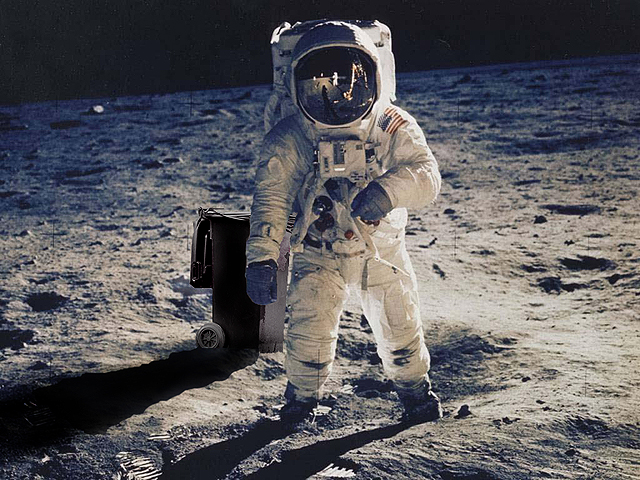
Of Moon Walks and Broken Dreams: Rendering a Distant Memory
a repost --- in honor of the 42 anniversary of the moon walk...

I have been trying to write about the 40th anniversary of Apollo 11 since last week. I wanted to write a piece that talked about where I was on that historic evening during the summer of 1969. The summer was tumultuous for all sorts of reasons - political, historical and personal. It was one of those touchstone moments in my life where everything was changing and falling apart around me, and I wouldn’t understand the significance of the confluence of events until much much later. This is one of the reasons I was having such a hard time writing about it from my adult perspective – I couldn’t find the narrative voice of a younger self who could tell the story with immediacy and honestly.
Last night in writers’ group, for our writing prompt, Alison Hicks placed dozens of visual images on the floor and asked us to find one that called to us. I found a surrealistic landscape with a haunting moon hanging low in the sky. I wrote July 20 1969 on the top of a clean page, then made a decision that helped me get inside of the narrator’s mind.
I created a third person limited narrator that was telling the story from the perspective of a 17 year old girl. Here’s what I wrote:
July 20, 1969
It is early evening and she doesn’t remember how she got here or which one of her girlfriends gave her a ride in their father’s Chevvy. She knows one of them did, Randy or Andie, maybe because she doesn’t drive. She’s been here for hours, and the tweed fabric of the orange sofa chafes against the skin behind her knees as she leans forward, still staring at the large black and white TV – an RCA floor model in a maple cabinet, console type with shiny metallic woven cloth covering the speakers on either side of the flickering screen.
She’s not alone, but she sure feels like she is. She hasn’t spoken to anyone since Randy, or was it Andie, left after seeing what was going on here. There is nothing more boring than a bunch of scagged out boys in front of a television set in the unairconditioned living room of a semi-detached brick box in Northeast Philadelphia. She felt the same way, about the boredom that is, but what kept her here was Dock – the boy whose house it was, the boy whose parents left him alone for two weeks while they drank mai tais and attended luaus in Honolulu, and the boy she had been madly in love with since she was fourteen.
It was the summer of 69, the summer before 12th grade, and less than a month before Woodstock and her planned getaway with Dock, though she hadn’t quite figured out what to tell her mother, or even how she was going to convince Dock to take her along with him and the boys when they went to the rock festival.
She let her eyes stray from the television set and wander around the room. The shades were drawn and the volume on the TV had been turned off and the stereo turned up – Walter Cronkite replaced by Jim Morrison. A quick furtive glance at Dock, and she saw that he hadn’t moved from where he’d been for the past hour – lying back, leaning against the wall, face towards the TV, but with his eyes closed.
She shivered slightly though the room was warm and still. She spotted the spoons with their burned bottoms, tiny pieces of cotton still in the center. She looked back at Dock and her eyes drifted up to see a splatter of blood on the wall and the pole lamp. For a moment, she had the urge to go into the kitchen and find some cleanser or bleach and scrub the evidence from the wall, but was stopped by the sight of a girl she had never seen before leaning languidly against the archway between the living room and kitchen, a needle still dangling from her veins. She had never seen a girl shoot up and this girl’s eyes were closed and she was shifting her weight and her hips were moving slowly back and forth. A soft noise like a purr was coming from deep inside her.
Dock had gotten up, and was standing beside the moaning girl as she leaned into his body.
“Damn!” Dock said slowly, as he matter of factly removed the needle from her bruised arm. “Can you fuckin’ believe it? One day we can tell our kids that we watched the men on the fuckin’ moon scagged outta our brains!”
With that, he returned to his spot against the wall, closed his eyes and turned back towards the TV.
Of course there’s more to the story. Of course I never got to Woodstock. It was all in my head anyway. Besides, one week before Woodstock, Dock’s best friend Steve died of an overdose and all of our lives were changed forever. Dock lived to be 50, I understand. Heard he moved to Florida, got married, had children even. I wonder what he told his children about where he was when the men walked on the moon.

I have been trying to write about the 40th anniversary of Apollo 11 since last week. I wanted to write a piece that talked about where I was on that historic evening during the summer of 1969. The summer was tumultuous for all sorts of reasons - political, historical and personal. It was one of those touchstone moments in my life where everything was changing and falling apart around me, and I wouldn’t understand the significance of the confluence of events until much much later. This is one of the reasons I was having such a hard time writing about it from my adult perspective – I couldn’t find the narrative voice of a younger self who could tell the story with immediacy and honestly.
Last night in writers’ group, for our writing prompt, Alison Hicks placed dozens of visual images on the floor and asked us to find one that called to us. I found a surrealistic landscape with a haunting moon hanging low in the sky. I wrote July 20 1969 on the top of a clean page, then made a decision that helped me get inside of the narrator’s mind.
I created a third person limited narrator that was telling the story from the perspective of a 17 year old girl. Here’s what I wrote:
July 20, 1969
It is early evening and she doesn’t remember how she got here or which one of her girlfriends gave her a ride in their father’s Chevvy. She knows one of them did, Randy or Andie, maybe because she doesn’t drive. She’s been here for hours, and the tweed fabric of the orange sofa chafes against the skin behind her knees as she leans forward, still staring at the large black and white TV – an RCA floor model in a maple cabinet, console type with shiny metallic woven cloth covering the speakers on either side of the flickering screen.
She’s not alone, but she sure feels like she is. She hasn’t spoken to anyone since Randy, or was it Andie, left after seeing what was going on here. There is nothing more boring than a bunch of scagged out boys in front of a television set in the unairconditioned living room of a semi-detached brick box in Northeast Philadelphia. She felt the same way, about the boredom that is, but what kept her here was Dock – the boy whose house it was, the boy whose parents left him alone for two weeks while they drank mai tais and attended luaus in Honolulu, and the boy she had been madly in love with since she was fourteen.
It was the summer of 69, the summer before 12th grade, and less than a month before Woodstock and her planned getaway with Dock, though she hadn’t quite figured out what to tell her mother, or even how she was going to convince Dock to take her along with him and the boys when they went to the rock festival.
She let her eyes stray from the television set and wander around the room. The shades were drawn and the volume on the TV had been turned off and the stereo turned up – Walter Cronkite replaced by Jim Morrison. A quick furtive glance at Dock, and she saw that he hadn’t moved from where he’d been for the past hour – lying back, leaning against the wall, face towards the TV, but with his eyes closed.
She shivered slightly though the room was warm and still. She spotted the spoons with their burned bottoms, tiny pieces of cotton still in the center. She looked back at Dock and her eyes drifted up to see a splatter of blood on the wall and the pole lamp. For a moment, she had the urge to go into the kitchen and find some cleanser or bleach and scrub the evidence from the wall, but was stopped by the sight of a girl she had never seen before leaning languidly against the archway between the living room and kitchen, a needle still dangling from her veins. She had never seen a girl shoot up and this girl’s eyes were closed and she was shifting her weight and her hips were moving slowly back and forth. A soft noise like a purr was coming from deep inside her.
Dock had gotten up, and was standing beside the moaning girl as she leaned into his body.
“Damn!” Dock said slowly, as he matter of factly removed the needle from her bruised arm. “Can you fuckin’ believe it? One day we can tell our kids that we watched the men on the fuckin’ moon scagged outta our brains!”
With that, he returned to his spot against the wall, closed his eyes and turned back towards the TV.
Of course there’s more to the story. Of course I never got to Woodstock. It was all in my head anyway. Besides, one week before Woodstock, Dock’s best friend Steve died of an overdose and all of our lives were changed forever. Dock lived to be 50, I understand. Heard he moved to Florida, got married, had children even. I wonder what he told his children about where he was when the men walked on the moon.

Tuesday, July 12, 2011
Looking/Back
My back hurts a lot.
All the time.
My friend Elizabeth who knows about chakras and energy medicine and reiki and tarot and goddess wisdom and more tells me: People with back pain live in the past. It is your past pushing up behind and against you. Let it go.
So I have been reading about quantum touch and energy meridians and natural healing.
“Your memory is not in your mind,” Bert Jacobson says.
He is my gentle and brilliant chiropractor and he is working on my back as he speaks. “It’s in your body," he continues. “Your cells remember everything and they pass that information on to the new generation of cells.”
I have brought my eighty-three year old mother to see Dr. Bert. Two years after her knee replacement, doctors are now recommending that she replace her hip. I am hoping that chiropractic can spare her this misery.
He examines her carefully and thoroughly, speaking to her softly as he tries to help her get in sync with her own body. As he touches her, he begins to “read” her history.
“Something’s happened to you that’s thrown everything off," he says. “Tell me the history of your foot.”
So she tells him the story, how at age 37, at the peak of her life, the top of her physical strength, she fell on the ice on a snowy day in 1967 and broke her ankle. It was a very complicated break, one that took several pins and three operations to get "right."
Only the doctors never got it right. After that fateful day, I never again saw my youthful mother bound up the stairs to the second floor or walk briskly through our neighborhood. She has spent the rest of her life out of alignment, off balance and walking with a crooked gait which finally wore away the cartilage around her knee and now was doing its damage to her hip.
“I can unlock your ankle,” Dr. Bert says taking her left foot in his hands and showing us how it is completely frozen and splayed. 'This will help to equalize your gait and take some of that pressure off of your hip."
Wanting desperately for her to give chiropractic a try before submitting to more rounds of cortisone shots, torturous physical therapy and additional surgery, I tell her all that I have been reading about mind-body connection, cellular memory and quantum healing.
Later that night, when the phone rings, I hear that quiet tentative voice she always uses when she’s remembered something or had a new insight.
“You know," she practically whispers. "You got me thinking about something.”
I inhale and wait.
“When I was a girl, your Bubbe, my mother,” she begins hesitantly, “used to curse me sometimes in Yiddish. “
I continue to hold my breath.
"When I was bad, she’d say, 'Tsebrekhn dayn fus.'"
“She didn’t mean it,” she quickly adds. "It was just something she’d say out of frustration, then she’d apologize. But it stayed with me, I guess.”
“What does it mean?” I ask, wishing for the thousandth time that she had taught me this flexible and enduring language instead of using it as a form of secret communication with the elders to keep secrets from us children.
“It means, ‘Break your foot.”
The past hangs silently in the air between us.
We both exhale, and I let myself wonder if she is thinking about what things she might have said to me when I was small, what curses may have passed her lips in anger that still live in my cells today.
And as I hang up, I rub my back, trying [not] to remember all I may have said to my daughter in the past.
photo credit: sankofa http://media.photobucket.com/image/sankofa/starrz3058/sankofa.gif?o=2&sortby=sevendaysview
Friday, June 24, 2011
Silent Treatment
You told me once
when you were still talking to me
how you love voices.
No two are alike, you said.
Like people or snowflakes.
Both a noun and a verb,
the organ of the soul,
voice rouses memories
and quickens the pulse.
Voice is alive.
There is no sound
without breath.
My favorite sound -
a sigh of exhalation
the ~~ahhhhhhh~~~
of surrender.
I love that voice is born in vibration.
Intention, the bow which glides
across the strings in our throat.
Or perhaps I've forgotten
that the voice has a mind of its own.
A sympathetic stirring
of heart strings and vocal cords
that bypasses the will.
The heart sings - the voice celebrates.
The heart cries - the voice despairs.
Today, in my "Theater of the Oppressed" class,
the teacher says:
“Oppression occurs when there is only monologue, no dialogue.”
I think of you and shudder.
I am Medusa, slayed by the sound
of her solo voice-
the echo in the mirror
turning her into silent stone.
Still.
My voice is drawn into your silence.
Like island people with multiple words for the sea
or desert nomads pondering the infinite changeable sky,
those forced to dwell in this banishment know
but do not reveal to others
(except for me, telling you, here)
there are many states of silence.
Listen:
We are but water and energy
two parts hydrogen, one part oxygen
vibrating through flesh and bone.
And every compound living or inert
has its base of absolute zero.
where all is still.
The big quiet.
The range and depth of silence
is not an abstraction.
It lives in the spaces between.
Like me.
John Henry Fuselli - Silence
when you were still talking to me
how you love voices.
No two are alike, you said.
Like people or snowflakes.
Both a noun and a verb,
the organ of the soul,
voice rouses memories
and quickens the pulse.
Voice is alive.
There is no sound
without breath.
My favorite sound -
a sigh of exhalation
the ~~ahhhhhhh~~~
of surrender.
I love that voice is born in vibration.
Intention, the bow which glides
across the strings in our throat.
Or perhaps I've forgotten
that the voice has a mind of its own.
A sympathetic stirring
of heart strings and vocal cords
that bypasses the will.
The heart sings - the voice celebrates.
The heart cries - the voice despairs.
Today, in my "Theater of the Oppressed" class,
the teacher says:
“Oppression occurs when there is only monologue, no dialogue.”
I think of you and shudder.
I am Medusa, slayed by the sound
of her solo voice-
the echo in the mirror
turning her into silent stone.
Still.
My voice is drawn into your silence.
Like island people with multiple words for the sea
or desert nomads pondering the infinite changeable sky,
those forced to dwell in this banishment know
but do not reveal to others
(except for me, telling you, here)
there are many states of silence.
Listen:
We are but water and energy
two parts hydrogen, one part oxygen
vibrating through flesh and bone.
And every compound living or inert
has its base of absolute zero.
where all is still.
The big quiet.
The range and depth of silence
is not an abstraction.
It lives in the spaces between.
Like me.
John Henry Fuselli - Silence
Friday, June 10, 2011
Two Poems about Teaching: For my Teacher Friends as Another Year Closes
Subscribe to:
Posts (Atom)