Friday, August 1, 2014

Finding a Writing Practice In 17 Syllables


Soon after I retired from teaching high school for thirty-five years,  after hearing the  voice inside my head say, “If you don’t stop teaching you are going to die,”  I decided to look into MFA programs in Creative Writing.

I had supported others in their writing for over three decades, smiling proudly as my students won accolades, and had the plays they’d written under my tutelage produced on stages in Philadelphia and New York, all the while pushing down further and further my own desires to write. 


Perhaps those desires are what gave voice to the death threat that came to me while I stood poised before a blackboard, chalk in hand and mouth agape as all words stuck in my throat.  And it was definitely those desires that prompted me to call one of the top low residency MFA Creative Writing Programs on the east coast to inquire about application requirements.

On this particular morning,  I had gotten up the nerve to call the admissions office of  said “Top Program” when I found myself speaking to the admissions director.   He spoke in a high Boston Brahmin accent which immediately intimidated this working class Philly girl and I had to brace myself when he said, barely masking his condensation, “Well do tell me about your writing practice.”

“I’m sorry,”  I replied.  “I don’t understand what you mean.”

“You must have a serious writing practice before we can consider you for admission," he replied with more than a touch of disdain. 

I was flummoxed.  I’d never heard of a “writing practice” before.  I’d heard of a teaching practice.   In fact I’d had one for over thirty years.  But a writing practice?”  What was that??  And why did I need one before enrolling?  Wouldn’t the program teach me how to become a writer and to develop a practice?

I hung up quickly then sunk into the inevitable depression which accompanies the sudden dashing of the only plan you’d made for the rest of your life.   Stuck in a Catch-22,  I had wanted to go to school to develop a writing practice, but it seemed that I needed a writing practice to get accepted into school.

It was the structure and discipline of school that I thought I needed.  That and a supportive, nurturing and challenging community.   I had never really been able to learn anything on my own.  And I had no clue how to develop and sustain a practice. 

In the years that followed I tried. I found a writing group in my neighborhood lead by Amherst Writers and Artists alum and poet AlisonHicks.  I went to writers' conferences and retreats around the country. I became connected with A Room of Her Own Foundation, a non profit whose mission it is to support the development of women writers.  And I tried my hand at blogging.  But I couldn’t discipline myself to sustain it. 

Seventeen syllables changed all that.

Photo credit - Nicole Galland - The Haiku Room 


One January 1, 2014, a post from one of the women I’d met at the last AROHO retreat came through my newsfeed on Facebook.  Take the Haiku a Day Challenge, it said.  Join with others to explore the possibilities of this ancient, poetic form.

I’d never written a haiku.  I’d read some Basho in a Japanese Literature course in 1972 as an undergraduate and I’d taught the rigid 5-7-5 syllable structure to resistant adolescents in high school English classes.

“Why do we have to follow that stupid form?”  they’d argue.  “This is repressive!!!” they’d shout.  And “How dare you stifle my creativity with a formula???!!! You’re a poem Nazi!!!!”

But something about this appealed to me.  So I wrote my first haiku:


 as his fist descends
            her mind body splits in two
     one escapes the blows


***************************************************************************

It’s August 1 and I have written and posted at least one haiku a day since the first of the year.   And three really amazing and unexpected things have happened:

First, I have gotten much better at it – far more precise in my word choice,  daring in my images, confident in my subject matter.

Second, people have shown their appreciation for my work through immediate feedback providing instant gratification which is a great motivator.

And third,  my writing of haiku has inspired others to do the same.   I post the poems both in the closed “Haiku Room” and on my personal page on Facebook.  One of the best things that has happened is that several of my former high school students have subsequently taken the challenge and post their daily original haiku to the page along with the 250 other poets.

I get to start each morning exploring subjects I care about,  tell stories which mean something deep and profound to me and compress complexity into three lines and seventeen syllables.  I get to explore images and stories from my childhood, from fairy tales and mythology.   I get to encounter unexpected insights within the artful juxtaposition of seemingly unrelated things.   All within a supportive and responsvie community of writers.

And for the first time in my life,  I can honestly say that I HAVE a writing practice. 


A sampler of my Haiku from The Haiku Room 


at death our flesh turns
into words those who love us
whisper to themselves


with his hoarder's heart 
and miser's lips he turned her
into a beggar


she is a girl who
dreams of keys in love with a
boy who collects locks


her body becomes
a bridge across his abyss
of silent longings


photographers stalk
their prey with cameras drawn
frame and hang their kill


you will disappear
like words i write with water
on sand in the sun


Thursday, June 5, 2014

Of Cats and Trolls and the Healing Power of Storytelling


I have always believed in the transformative power of stories.   The most edifying aspect of my 35 year teaching career was working with Philadelphia Young Playwrights to teach young people how to write, revise and stage their own plays.  During those years, in classroom after classroom with student after student, I witnessed the impact that playwriting had on students, their teachers and all who saw their plays.

It is not an exaggeration to say that many of those plays changed lives. 

     Since retiring in 2008, I have remained connected and committed to storytelling in many different and exciting contexts. I still teach a little, present at workshops and organize writing retreats and conferences.  The latest one,  Many Women, Many Stories is coming up next week.   

       After all of these years of helping others, I am finally able to work on my own writing. There are wonderful writing conferences around the country and I have been lucky enough to attend, including one sponsored by A Room of Her Own Foundation at Ghost Ranch in Abiquiu, New Mexico. 


       And I have recently returned from a five week independent writing retreat in Santa Fe, where with the help of Tanya Taylor Rubinstein, I wrote the draft for a one-woman show tentatively entitled "The Soul of a Teacher" about the reciprocal healing that can happen between teachers and students through storytelling in a soul-based classroom.  Something I know a little bit about.  

       Retirement has allowed me lots of time to watch movies and I have become enamored with the history of film and everything related to filmmaking.  Since 2008, I have taken several screenwriting classes and workshops. “Small Steps,” a story about a teenage girl in Philadelphia, struggling to control her own destiny during the days between Apollo 11 and Woodstock in the summer of 1969 is my first screenplay. 


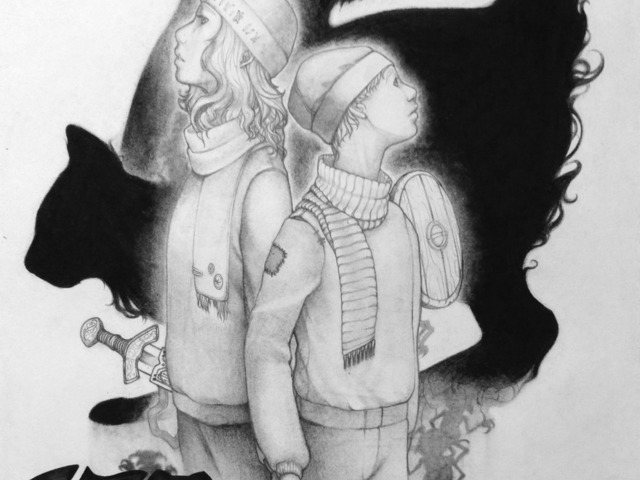
       Right now, I am excited because I have just become an investor in a low-budget independent film that I am anxious to tell you about.  "Cat and the Trolls" was written by my friend and screenwriting teacher Michael Amundsen.  Michael, who will also be directing the film, is an experienced filmmaker and a gifted storyteller.  I first learned of "Cat and the Trolls" when Michael read excerpts as a guest writer at the Taos Writers Conference in the summer of 2012.  What I heard was a powerful coming of age story about Siri, a young daughter of Norwegian immigrant farmers, who must protect her little brother during a deadly blizzard on the Montana plains in 1917.


       I was so taken with the story and with Siri, in particular, that I asked to read the entire screenplay. I have been hooked ever since.  I believe in this story and I really want to see it on the big screen so much so that I immediately volunteered to help. First, I taught myself how to knit in the traditional Norwegian style and I made scarves and mittens for the actors' wardrobe.  


       And now I have signed on as part of the team invested in getting this movie made.

       I am working hard and I am learning a lot.  First, I am learning that it is very hard in this economy to raise money to make anything other than action or horror films.  Second, I am learning that even highly successful veteran filmmakers like Spike Lee and Zach Braff are turning to crowdsourcing sites like Kickstarter to make their next movies, making it even harder for less well-known filmmakers with smaller film projects like "Cat and the Trolls" to get noticed.   The only way these small, but beautiful and moving stories can get funded is if people who believe in them make personal donations and then reach out to their networks for further support. 

       So that's what I am doing.  Reaching out to you to check out the web site for "Cat and the Trolls."  You will be able to see a promotional video and learn more about the story, about Michael, the talented cast and crew and other people who have committed to getting this film made. 

       Madeleine L'Engle wrote, "Stories make us more alive, more human, more courageous, more loving."  

       I know this is true.  It's what my life’s work has been about. And I feel this way about "Cat and the Trolls.”   So take a look.  See what you think.  Share it with your friends.  Then make a donation to help bring this story to life.


      Click HERE to pledge your support to 
Cat and the Trolls.
           No donation is too small and all are greatly appreciated! 

Tuesday, January 28, 2014

Artful Juxtaposition

http://momastery.com/blog/2012/01/04/2011-lesson-2-dont-carpe-diem/

In retrospect,  given the long view,  there are no surprises in life, really.  When you wrench events out of the chronological order in which you first experienced them,  or when you examine your life's experiences under the telescopic scrutiny of hindsight,  time conflates, and moments of being line up in new and different ways.  And such artful juxtaposition can reveal that what once seemed impossible, unexpected or beyond explanation was in fact, inevitable after all.

I am reading a book which is challenging the way I think  about time, chronology and experience.   It's called  The Art of Time in the Memoir, by Sven Birkerts and its sub-title is Then, Again.  The premise of the book is that when one engages in the process of writing memoir, the writer has the opportunity to discover the larger patterns and meanings in his or her life through the artful use of time.    

Something may have happened then -  right before another then or right after a different one.  But if you take the beads of experience off of the string of chronology and play around with new arrangements and possibilities, something magical happens:

Time, as we humans measure it, with shadows of sticks growing or shrinking in the sun light, or tocks predictably and precisely following ticks, melts away.  

It is then that we enter God-time. 

In God-time there is no past or future. There is only the infinite now  filled with untethered moments.  These free moments dance around one another in dizzying orbits, attracting and repelling like charged particles.  And with each new rearrangement of the moments of a life,  a new meaning reveals itself. 

A small example from my life. 

It is 2010  and I am in a hotel room in Greece waiting.  I have come to Athens to meet up with a group of women who will be writing and climbing mountains on the island of Naxos.  I am fifty seven years old and I am newly retired from a 35 year teaching career - a major transition in my life.    

I was excited about this trip, but I was frightened too.  I am not a very experienced traveller.  Too embarrassed to admit my fear,  I coyly suggest to my husband that he come to Greece with me the week before my trip and we would go on an Aegean cruise together.   He agrees to do it and if he knows why I invited him,  he is kind enough not to say.  Or maybe he just likes cruises or maybe he is  pleased to join me in Greece, even though deep inside he knows that I only want him along  because I am afraid to travel abroad alone. 

Athens Greece, 2010 
On the day that I am to meet the woman at a different hotel which is several blocks from the one I stay in with my husband,  he catches an early cab to the airport. 

I have several hours to kill in Athens and even though I am scared, I force myself to take a walk on the Plaka.  An hour later, I walk my bags to the new hotel.    I arrive way before the others and I sit alone in the sparsely furnished hotel room waiting for my roommate ( a stranger ) and the rest of the women to arrive.  

My husband is long gone. 

Juxtapose. 

It's June 16th, 1970 and I have just graduated high school.  I am seventeen and I have never been very far from home.  My parents are divorced and I live with my mother who has managed to get me ready to go to college with very little money nor help from my father.  He has however, agreed to drive me the 200 miles from Philadelphia to State College, PA.  I have fallen asleep on the living room floor, by the window of my mother's house, waiting for my father to come pick me up and deliver me to Penn State University where I will start college on June 17th. 

I am packed and ready when he arrives at the door at 5:00 in the morning. Dawn has barely broken and I have hardly slept, having stayed out late saying good bye to all of my high school friends who won't be starting college until the fall.  I get in the the car with my father who silently loads all of my earthly possessions into the back seat of his car.  Soon I fall back to sleep as he makes his way along the Pennsylvania Turnpike,  through Harrisburg, across the Susquehanna River and up Route 322 West.   It was over forty years ago and the roads weren't nearly as developed as they are today. It took four hours to get there.  

Penn State University, circa 1971

Still. I was all checked in, unpacked and left alone in my sparsely furnished dorm room waiting for my roommate ( a stranger ) to arrive by 9:00 AM.  I sat alone in that room for hours.


My father is long gone.  


Each of these small moments has a meaning of its own.  The trip to Greece, coming right after my retirement represents a transition between my being with my husband and my being on my own.  It's an important moment in my life. 

And here, as this moment butts up against another from my first day of college,  a space opens up in the thicket of time and I see myself being transported by a different man, this time my father who leads me to the threshold of a new life, then leaves me alone to wait for it to begin. 

Then, and then, again.  I see myself in God's time, across decades and continents doing a dance of dependence and breaking free which continues to give shape to my life. 

With LiYun Alvarado on the top of Mt. Zeus.  Naxos, Greece, 2010


Tuesday, July 9, 2013

Express Yourself


        It’s been a while since I opened the doorway to my own imagination and stood at the entrance facing endless possibilities.

        It’s not like I’ve been idle.  Quite the opposite really.  I’ve been taking a drawing class this summer. 

It is my first studio art class and I am very unnerved every time I have to turn my easel around for the dreaded class critique. 


       “Okay group what do we think of Marsha’s drawing?” the teacher asks and before any one can answer, he says,  “Here we have a very expressive drawing,” or “She’s so expressive,” or “Look at the expression in this figure.”

        Oh yes. I am so expressive. 


       There I go again, expressing my damn self all over the place.


       Lately I have been sitting at my piano for hours expressing myself by playing chord progressions with my left had and trying out different notes with my right.  I have an attraction to diminished and other unresolved chords and recently I’ve become bold enough to add 9ths and even 11ths.  And while my left hand repeats the chord patterns, my right hand experiments, switching keys, going minor and exploring melodic possibilities. 


        I can do this for days until I find myself repeating the same combination of notes and rhythms each time I sit down to play, and a true melody emerges. It is then I know that a new song song has found me.


         I have written five songs in the past four months,  more than I have written in my entire life until this point. Real ones too with key signatures and melodies and bridges and refrains and some of them even have words.

        Groping.

        I am always groping.

        There is always a space between what I am expressing in charcoal,  or notes or words and what I envision.

        My grasp has always been exceeded by my reach.


         Except in my writing.

         It’s not that there aren’t spaces between what I envision and what becomes manifest.  But unlike music and drawing, where I am a novice,  I have spent my entire adult life honing the skills that I need to be my best expressive self in writing.

        Still, at home, I wander from easel to piano  - anywhere but my desk.

        What is it that I am afraid of?  What spaces do I fear to enter?

        Last week,  I read Neil Gaimon’s new novel, The Ocean at the End of the Lane  and from the moment I finished the prologue, I knew.  


        I want to write like that.

        I want to go where Neil Gaimon goes – to the land of dreams in the fantastical world of childhood, where there is no line between what adults call real and children call magic. 

        I want to go to that place where time is a fabric that can be cut and stitched and stretched and wrapped around stories, with characters that live forever in lands that are populated with dragons who sing arias and monsters who knit sweaters and kings who decree that all children in their kingdoms must learn to fly.

        I want to go inside the pink bedrooms of teen-age girls who wake one morning to find that feathers have erupted from bloody slits that appeared in their shoulder blades overnight and I want to stay there and bear witness to the moment they first take flight.

        I want to stand outside the stone cottage of a lonely old woman whose house is enveloped by honeysuckle and strangled by ivy and listen to the children tell each other tales of how she is a witch who ate her children  over two hundred years ago when they were small and how she is doomed to live out their lifespans, the ones she swallowed, the ones she devoured.

        I want to be among those children as they dare each other to knock on her door on a warm still summer night and I want to see her gnarled hand reach out from behind the crack in the door and yank a boy who seconds ago was filled with bravado as he danced on the witch’s doorstep, but whose eyes now pop in terror as he vanishes inside the house.

        I want to come back to Shayna Mandel, Tiger Mendlebaum and Bobby “Oh Say Can You See?” Olansky and walk with them to that liminal space between childhood and the end of innocence;  between consensus reality and the shimmering world of their own dreams, between the conscious and the unconscious.

        Between faith and fear.

        I want to enter those spaces and when I write,  I want to share with others what I have found there.